
Solutions for Direct-to-Consumer Brands
Every new customer costs more than the last one, and a growing share of them are buying somewhere that keeps the data instead of you.
Amazon alone now accounts for nearly 40% of all US ecommerce sales and more than 79% of US retail-media ad spend,[1] and in a five-country survey, 63% of shoppers said they now prefer buying on a marketplace over a brand’s own site.[2] Every sale that happens there is a shopper whose email, order history and lifetime value your brand never actually captures. Meanwhile, acquiring that shopper in the first place keeps getting more expensive, and retaining one you already have can cost up to 5x less.[4]
StoreConnect closes that gap natively inside the Salesforce platform your brand already runs: no new vendor, no new integration surface, no new system for your team to learn. We build the product. Our certified Salesforce implementation partners deliver it for you, backed directly by our team.

Why now: the cost of waiting
Higher year-over-year share-price growth for companies with an established D2C business, 2012 to 2022.[3]
of shoppers now prefer a marketplace over a brand-owned site, and 47% start discovery there rather than on search.[2]
of online sales are returned, at $20 to $40 per item once shipping, inspection and restocking are counted.[5]
The cost of acquiring a new customer versus retaining one you already have.[4]
Where the gaps are costing you today
Every new customer costs more than the last one
Acquisition and retention run as two budgets, reported by two teams, with no shared view of which channel produced a customer worth keeping.
Your brand is scattered across marketplaces you don't control
Every sale there is real revenue, and a shopper whose email, order history and next purchase you never get to see.
Recurring revenue leaks out the back door
A meaningful share of subscription churn is not a customer deciding to leave. It is a card that failed to charge and was never recovered.
Returns are eating margin nobody budgeted for
Nearly one in five online orders comes back, and free returns are exactly what persuaded the shopper to buy in the first place.
Switching platforms means starting the brand over
Migration cost, not a missing feature, is what keeps brands on a platform they have already outgrown.
Who actually builds and runs this?
A platform is only worth as much as the partner who deploys it into a live brand with a campaign calendar to hit.
Every new customer costs more than the last one
Customer acquisition cost has been climbing for years as ad auctions get more competitive and platforms compete harder for the same attention. McKinsey’s research is blunt about the fix: acquiring a new customer can run up to 5x the cost of retaining an existing one, and CAC alongside marketing ROI at the individual-customer level are the efficiency indicators a D2C brand actually has to manage.[4] Most D2C brands still run acquisition and retention as two separate budgets, reported by two separate teams, with no shared view of which channel produced a customer worth keeping. The payoff for getting it right shows up at the top: companies with an established D2C business saw 30% higher year-over-year share-price growth than peers without one across 2012 to 2022.[3]
One B2B and D2C brand managing more than 10,000 SKUs named streamlining quote to order as a core need, because that workflow currently spans several disconnected systems, costing them visibility into the sales pipeline and opportunities to improve conversion.[13] That is the real cost of disconnected systems: not just higher overhead, but slower, less predictable revenue.
Unifying marketing spend and Salesforce customer data means CAC and retention get optimized together. The same record shows what a shopper cost to acquire and what they are actually worth over time, rather than two disconnected numbers reconciled by hand at the end of the quarter.
- Acquisition spend and customer records in the same Salesforce org, not two reports reconciled by hand
- CAC, repeat purchase rate and lifetime value on standard Salesforce objects
- Campaign attribution and abandoned-cart recovery included, not bolted on
- Quote to order in one workflow, so pipeline visibility is not lost between systems

Your brand is scattered across marketplaces you don't control
Amazon alone holds close to 40% of all US ecommerce sales, more than four times its nearest competitor, and takes in more than 79% of US retail-media ad spend.[1] Shoppers have followed: 63% now say they prefer buying on a marketplace over a brand’s own website, with 47% using marketplaces for product discovery ahead of Google itself.[2] In Australia, 69% of online shoppers use marketplace apps alongside retailer and brand sites directly.[6] Every one of those transactions is a real sale, and a shopper whose email, order history and next purchase your brand never gets to see or influence directly.
The same brand also pointed to fragmented data as the blocker: customer data sits across different sales channels and platforms, so nobody can see the full picture, which in turn prevents confident decisions about inventory and customer engagement.[13]
An owned storefront good enough to actually bring shoppers back to it, built on the same Salesforce data as the rest of the business, turns “sold through a marketplace” back into “a customer we know.”
- A storefront and a customer record inside the Salesforce org you already own
- Every order, email address and lifetime value on your own Accounts and Contacts
- Marketing Cloud journeys triggered natively off any transaction, with no connector to re-license
- Sell wherever your shoppers are and keep the owned relationship on the same record

The most obvious benefit of StoreConnect has definitely been the ability to integrate our eCommerce solution almost seamlessly with Salesforce. All our marketing, CRM and ecommerce systems are in the same ecosystem - giving us a 360 degree view of our sales, marketing and customer service.
Subscriptions and recurring revenue leak out the back door
Recurring revenue looks stable on a dashboard right up until churn quietly erodes it, and a meaningful share of that churn is not a customer who decided to leave. It is a card that failed to charge and was never recovered.[8] Subscription brands that treat voluntary cancellation and failed-payment churn as the same problem miss the cheaper, more preventable half of it.
A subscription wine community described the challenge as complexity on three fronts at once: handling recurring billing, keeping members engaged through fresh content, and reducing involuntary churn from failed payments, all of it currently spread across disconnected systems and costing revenue that was never meant to leave.[12]
Built-in recurring billing paired with payment recovery catches the involuntary-churn share before a lapsed card quietly becomes a lost subscriber.
- Auto-renewing subscriptions, fixed-term or evergreen, on standard Salesforce objects
- Automatic retries on failed payments, before a lapsed card becomes a lost subscriber
- Self-service portal where members update their own payment details
- Subscription, order and engagement history on one Salesforce customer record

Returns are quietly eating the margin nobody budgeted for
An estimated 19.3% of online sales are returned, and once shipping, inspection, restocking, customer service and markdowns are counted, each one costs $20 to $40.[5] But returns are not optional to skip: 82% of shoppers say free returns are an important consideration when buying online at all.[5] Free shipping (75%), simple or free returns (60%) and loyalty programs (56%) are consistently the top three things that move a shopper from browsing to buying,[7] and 86% of shoppers now buy across a mix of retailers, brands and marketplaces, so the comparison is always one click away.[7] Cutting returns friction and cutting margin are, in practice, two versions of the same problem.
Pairing a smoother returns experience with a rewards program that gives shoppers a reason to keep the item, or come back for the next one, protects margin without becoming the friction point that costs the next sale.
- Returns, refunds and exchanges processed against the original order
- Returned stock goes back to the same single pool it was sold from
- Loyalty points, gift cards, vouchers and account credit on one balance
- Native Salesforce reporting on return rate by product, channel and segment

Customers can access products at their membership price or use points to make purchases. Sustainable Salons also have access to this data all in Salesforce, making reporting easy and accurate, allowing them to see how their customers interact with the platform and expand their offerings to match.
Switching off your current platform shouldn't mean starting the brand over
Migration cost is commonly the real reason a brand stays on a platform it has outgrown. Estimates for moving off a platform like Shopify or WooCommerce run from around $5,000 for a simple store to $50,000 or more for a heavily customized mid-market build, with total first-year cost reaching $50,000 to $120,000 once platform, apps and agency support are counted.[9][10] A meaningful share of merchants who would financially benefit from switching never do, because the switching cost, not a missing feature, is what stops them.[9]
None of that has to be rebuilt here: existing payment providers and existing integrations stay connected rather than replaced when a brand moves onto StoreConnect.



- Runs on the Salesforce org and licenses you already hold
- Bring your own payment gateway and merchant account
- Works alongside your existing Salesforce integrations and custom objects
- SOC 2, ISO 27001, PCI DSS 4.0.1 and GDPR as standard
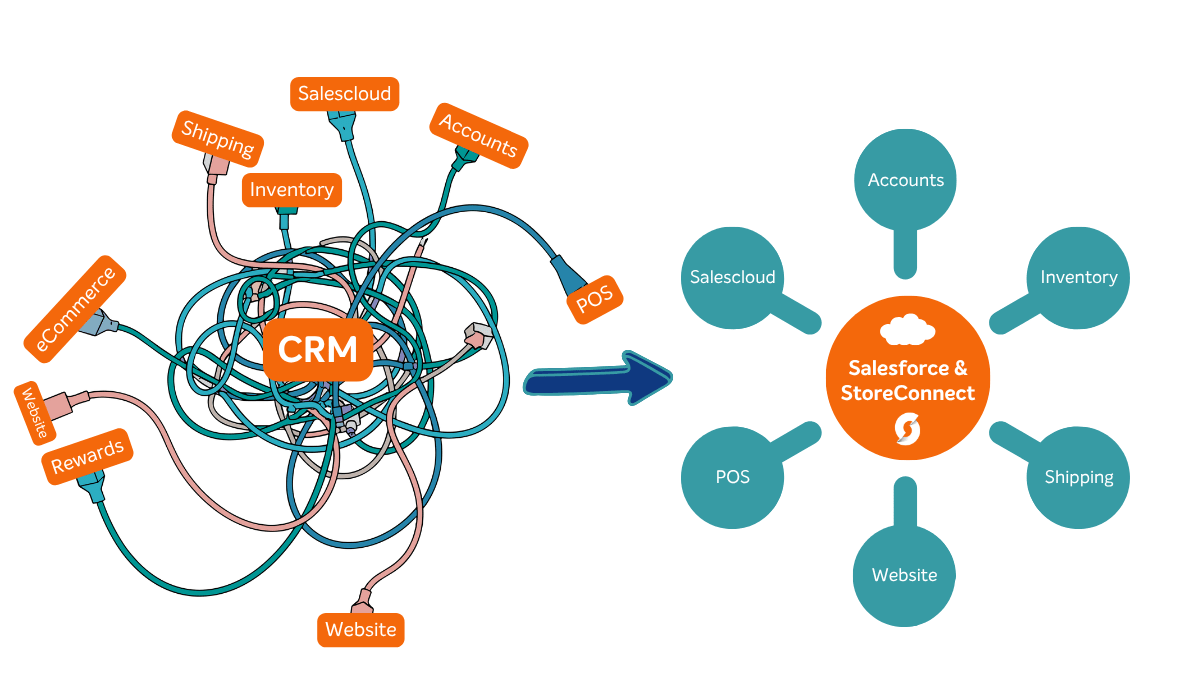
We build the product. A certified Salesforce partner delivers it.
StoreConnect is a product company. We build and support the platform; we do not run implementation delivery ourselves. Every deployment is delivered by a certified Salesforce implementation partner, with StoreConnect providing the platform, the product roadmap and direct technical support throughout.
- An implementation partner who already knows D2C speed expectations, campaign calendars and often your existing Salesforce org
- A product roadmap and support relationship with StoreConnect directly, not a black box owned entirely by the SI
- No SI partner yet? We will introduce you to one already certified on StoreConnect for consumer and D2C brands
- Automatic annual upgrades on every plan

If you’re already using Salesforce, to me it just makes complete sense to use StoreConnect for all your commerce requirements.
References
- FAQ on ecommerce marketplaces: the shift from Amazon-only to multi-marketplace. eMarketer. Supports Amazon at 39.7% of US ecommerce sales and more than 79% of US retail-media digital ad spend. ↩
- Marketplace shopping behavior report 2025. ChannelEngine, reported via Retail Brew. Five-country survey, 4,500 respondents. Supports 63% preferring marketplaces over brand-owned sites and 47% using marketplaces for discovery ahead of search. ↩
- The direct-to-customer edge: increasing shareholder value through business building. McKinsey. Supports 30% higher year-over-year share-price growth, and 7% higher P/E multiple growth, for D2C-established companies across 2012 to 2022. ↩
- DTC e-commerce: how consumer brands can get it right. McKinsey. Supports the up-to-5x acquisition-versus-retention cost figure and the CAC and marketing-ROI framing. ↩
- 2025 retail returns landscape. National Retail Federation, with Happy Returns and UPS. Supports the 19.3% online return rate, the $20 to $40 fully loaded per-item cost, and the 82% free-returns figure. ↩
- eCommerce report 2026. Australia Post. Supports 69% of Australian online shoppers using marketplace apps alongside retailer and brand sites. ↩
- Connected shoppers report. Salesforce. Supports 86% of shoppers buying across retailers, brands and marketplaces, and the free shipping (75%), returns (60%) and loyalty (56%) purchase-likelihood levers. Cross-retail consumer survey, not a Commerce Cloud product result. ↩
- DTC subscription churn index 2026. Eightx, summarizing Recharge panel data. Supports the directional claim that a meaningful share of subscription churn is failed payments rather than genuine cancellation. Secondary source; no churn percentage is stated on this page for that reason. ↩
- 27 ecommerce migration statistics that guide successful platform transitions. Swell. Supports the replatforming cost ranges and the switching-cost-as-blocker point. Agency estimate, not audited primary research. ↩
- Shopify migration: process, costs and tips. what.digital. Corroborating source for the migration cost ranges. Agency estimate. ↩
- Case studies. StoreConnect. The full collection of published customer stories across retail, manufacturing and education. ↩
- Customer interview, subscription wine community. Internal source, not publicly linkable. Rendered as a paraphrase of the stated need rather than a verbatim quotation. ↩
- Customer interview, B2B and D2C brand managing 10,000-plus SKUs. Internal source, not publicly linkable. Rendered as a paraphrase of the stated need rather than a verbatim quotation. ↩